By Jordan Trent, Majestie Barragan, and Reid Rogez
Overview
Research Question: Do ethnically targeted political campaign advertisements influence the voting trends of Latinos, and if so, does this in turn increase voter turnout?
We conducted a quantitative analysis of Latino voters survey responses after the 2016 Presidential Election survey in order to find answers for our research question. After running our data analysis, we were able to evaluate the data. Our findings showed weak positive correlations for both hypotheses.
Literature Review and Existing Trends
Micro-targeting
Micro-Targeting is when campaigns, businesses, or any entity target a particular group of people in order to earn their support. The messages presented in these targeted adds often vary by demographic in order to appeal to their specific characteristics. From the research, we found that television advertisements were the most effective form as they reached a large audience and can be aired in English and Spanish.
Another form of micro-targeting is Coethnic Contact. This is the use of personalized contact from an individual in your same ethnic group. This form of contact showed to have a significant effect on Latino voters and the Republican Party, but because Latinos are most often associated with the Democratic Party there was little effect due to coethnic contact.
Linked Fate
Linked fate is the collective group identity that forms in individuals who share common characteristics due to discrimination and marginalization. We believe that how connected a person is to their ethnic identity has an influence on the way they respond to targeted campaigns.
Spanish Language Media
The political advertisements shown on Spanish language media outlets are geared toward that specific demographic and often share a different message than those presented on English language media outlets, and they have more of an influence on the Latino community than English language media outlets. From our research, we found a study conducted by Matt Baretto and Bryan Wilcox-Archuleta that found advertising on Spanish language outlets led to an increase in voter choice for the party who ran the advertisement. The Spanish language media has a greater influence on Latino voters because they feel more trust towards the Spanish media outlets. In a different study conducted by Jennifer Merolla, Latinos show a higher level of interest in political engagement when exposed to Spanish political media. Increased interest can have a positive effect on Latino political participation as the more interested a person is, the more likely they are to get involved.
Another theme that stems from Spanish language media is The “Latino Vote”. It is used to describe the role that Latinos as a growing electorate can play in the political realm of the United States. Many of the advertisements played on Spanish language media outlets encourage individuals to go out and participate. As Latino political participation increases, we can see the influence targeted campaign advertisements have on the community.
Accessibility
By making certain news media and political information available to the Latino community, there is an effect on the amount they choose to participate in political world. One way the government has made participating an option for native Spanish speakers is by offering Spanish Language ballots. Research has shown that these ballots have an influence on the voting outcomes. Spanish language ballots are a form of targeting that allows for Latino voters to participate more, and it gives the community a chance to be on par in the political realm with the white and African American counterparts.
Theory and Hypotheses
By taking into consideration the roles that accessibility, Spanish language media, linked fate, and micro-targeting played, we were able to utilize this literature to form our two following hypotheses.
Hypothesis One: The more ethnically targeted campaign advertisements a Latino voter saw, the more likely these advertisements would affect their vote choice.
Hypothesis Two: If Latino voters are exposed to higher amounts of ethnically targeted political campaign ads, then they will have higher voter turnout rates as a result.
Research Design
We collected our data from the 2016 Collaborative Multi-Racial Post-Election (CMPS) Survey. There were 10,145 respondents in total, but we chose to focus solely on the 3,003 Latino respondents due to the focus of our questions. The survey was offered in Spanish and it was open to citizens that were registered or non-registered, as well as non-citizens.
Independent Variable: Which candidate the respondents voted for. It should be noted that only 3/4 of Latino respondents received this question because it was part of an experiment. However, those Latinos were randomly sampled and it does not effect our data findings.
Dependent Variable: How often, if at all, they saw ads micro-targeting the Latino community.
Controls: There were no controls placed upon this data set.
To run this data, we utilized IBM’s SPSS survey analysis software. Through this, we did a cross-tabulation on the data and a chi-square test as well. By using both of these tests we were able to define whether or not there was a correlation present for either hypotheses.
Findings
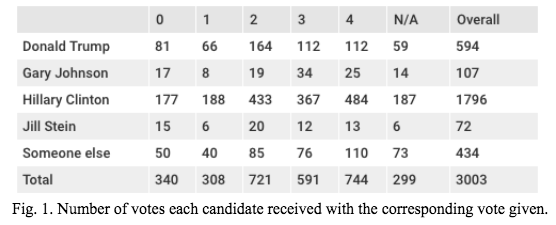
Our first figure shows some constants in our data and also supports our second hypothesis. The percentage of votes for Jill Stein, Gary Johnson, and Someone else stayed the same throughout exposure levels, showing a constant. Along with this, the number of total votes rose starting at exposure level two. This supports our second hypothesis.
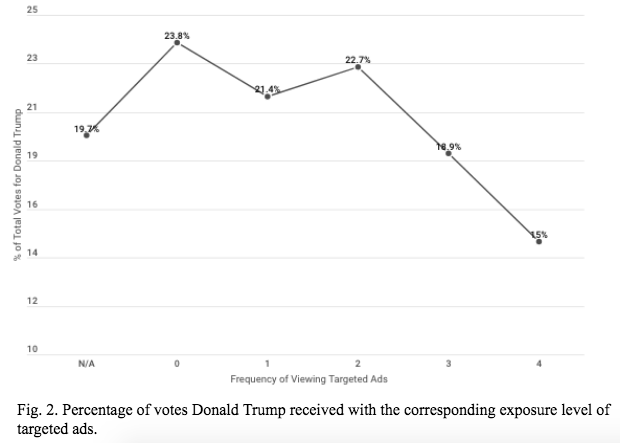
Figure 2 displays voting trends for Donald Trump with increased exposure to micro-targeting advertisements. These trends show that with increased exposure to ethnically targeted ads, Trump had a steady decline until he reached his lowest vote percentage with the highest exposure level. It should be noted, there is a major limitation. This limitation is that the candidate that voters saw the targeted ad for is unknown, so this correlation proves weak.
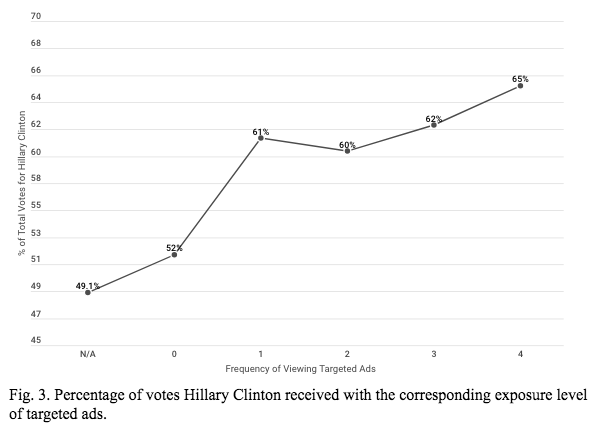
Figure 3 shows the voting trends of Latinos with increased exposure levels. This linear graph shows that with increased exposure to ethnically targeting advertisements, the percentage of overall votes also went up for Clinton. This goes to also support our first hypothesis by displaying a correlation between the dependent and independent variable. As mentioned in regards to figure 1, the limitation of not knowing the candidate of the ad causes this correlation to remain weak.
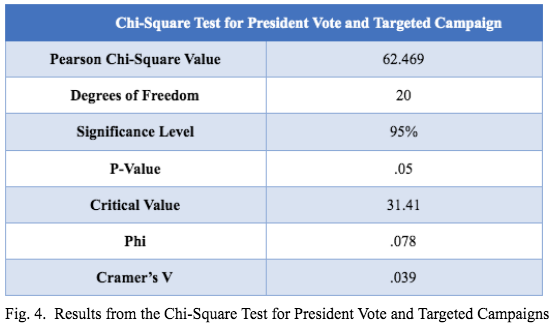
In figure 4, the Chi-Square value came out to 62.469. To show an association with the two variables, we compared that value to the critical value. This displayed that 62.469 is greater than 31.41, which displays that there is an association with the two variables. To determine the strength of that association, we analyzed the Phi and Cramer’s V values. With between 0.0 and 0.15, the relationship between the two variables is proven to be a very weak one.
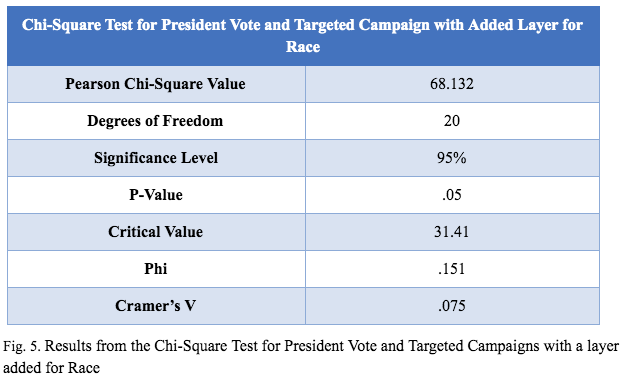
In figure 5, there is an added layer to test for race to measure it’s effects with the relationship between our independent and dependent variable. The Chi-Square value from this test is 68.132, and like in figure 4, we ran it against the critical value of 31.41. This test shows that even with the added layer for race that there is still an association with the two variables. Also similar to the findings in figure 4, the Phi and Cramer’s V values are no greater than 0.151 which shows a weak association.
These weak associations can be attributed to our large limitation of not knowing the candidate of the targeted advertisements. However, there are other limitations that arise as well. The other two limitations are that the prior political involvement and political affiliation of respondents was not controlled for. These variables can play a role in Latinos vote choice; therefore, by implementing a control for these variables in the future, a stronger correlation may be found.
Conclusion
Our results for the first hypothesis are showed a very weak positive correlation. Not knowing which candidate the ad came from makes deriving a universal finding impossible to confirm.
In hypothesis two, there is a weak positive relationship between targeted ads and voter turnout increase. Going forward, applying controls for both prior political involvement and political affiliation will help possibly strengthen the correlation.
Although these correlations between our independent and dependent variables are weak, they indicate that there is more research to be done surrounding this area going forward. Researching the mobilizing effects of micro-targeting will prove to be beneficial, especially for campaigns in future election cycles.

